


Explore the Brand New Nickerson Seed Book

Welcome to the first EVER Nickerson Seed Book!

Download Now white background

Nickerson Seed Book Download

Click to download your copy of the new guide!

For the very first time, you’ll find our entire range brought together in one place – Cereals, Pulses, Oilseed Rape, Maize, Circle Leys grass mixtures, plus our specialist Forage and Environmental seeds. A full catalogue designed to give you clarity, choice, and confidence when it comes to your seed decisions.

Nickerson are the Original Seed Specialists. For over 75 years, we’ve supplied seed and advice to British farmers – trusted by generations because we understand the job, the challenges, and what it takes to grow a successful crop. Our history gives us provenance. Our experience gives you peace of mind. When you choose Nickerson, you are not just buying seed – you are investing in a partnership.

That partnership is delivered through our nationwide team of Nickerson Seed Specialists. These are not simply salespeople – they are experts, practical thinkers, and trusted advisors. They know farming, they know seed, and they take the time to understand your business. Their role is simple: to help you make the best choice for every field, every season.

We are proud of our heritage, but we never stand still.

Farming is changing – new pressures, new opportunities, new demands on every hectare. Our job is to make sure you have the right seed, the right advice, and the right support to meet those challenges head-on.

This brochure is designed to help you do exactly that. It brings our portfolio together in one clear guide – from high-yielding cereals and resilient oilseed rape to productive maize, proven grass mixtures, and targeted environmental options. Every product has been selected, tested, and supported by Nickerson, so you can choose with confidence.

Quality seed. Trusted advice. Unmatched service. That has been our promise for over 75 years – and it remains our promise today.

Take a look at our 2026 Seed Book today.
David Watson reflects on his Alternative Forage Event
On 29th January, myself along with colleagues from the Northern Team, hosted an Alternative Forages Conference in and around Stocksfield and Ebchester, South Northumberland.

The event brought together industry experts, farmers, and stakeholders to discuss the benefits of home-grown forages in reducing costs, improving farm profitability, and minimising the environmental impact of livestock feeds, especially those that have been imported.

The day featured a number of insightful presentations from experts across the Industry:

Following the discussions, we then visited Broadoak Farm, where hosts Wayne and Geoff Bean demonstrated how they have successfully implemented the principles discussed during the conference. 

Myself and the Nickerson Northern team would like to thank all the guest speakers, and Geoff and Wayne Bean for their invaluable help with this event, and to Kelvin Cave Ltd for additional sponsorship.

We hope to see you at our next event!

More Information?
If you would like to know more about how these forages could help you on your farm please contact me on 07811 746804, david.watson@nickerson.co.uk

Exploring the potential of alternative forage crops: A training experience at LG Forage Crops Research Station

On October 29th and 30th, my Nickerson Seed Specialist colleagues and I had the privilege of attending an intensive training course at the LG Forage Crops Research Station in North Clifton, Lincolnshire. This event, led by John Spence, Limagrain Field Seed’s Forage Crops Product Manager, was an eye-opening experience into the world of alternative forage crops.

Hands-On Learning with Expert Guidance
Under John’s expert guidance, we explored a variety of forage crops including fodder beet, forage kale and rape, swedes and turnips, stubble turnips, lucerne, and forage rye. The hands-on nature of the training allowed us to inspect these crops in the field, providing a tangible understanding of their growth patterns and potential benefits.

Integrating Forage Crops into Farming Systems
A significant part of our discussions focused on how these crops could be effectively integrated into farming systems to enhance economic returns. We delved into the importance of not only selecting the right crop but also choosing the correct variety. This selection process is crucial for optimising livestock diets and reducing the reliance on bought-in concentrated feeds.

Economic and Nutritional Benefits
The course highlighted the substantial impact that alternative forage crops can have on modern farming systems. By improving livestock diets with these crops, farmers can achieve better health and productivity in their herds, ultimately leading to improved economic outcomes. The reduction in the need for external feed inputs also presents a cost-saving advantage.

Nickerson team of Seed Specialists receiving a technical briefing on forage crops from Limagrain Field Seeds Product Manager, John Spence in the trial plots at North Clifton, Lincolnshire

A Fascinating and Informative Experience
Overall, the training was a fascinating journey into the potential of alternative forage crops. It emphasised how these crops can play a pivotal role in sustainable farming practices, offering both economic and nutritional benefits. The knowledge and insights gained from this course will undoubtedly influence our approach to forage crop selection and integration moving forward.

More Information?
If you would like to know more about how these forages could help you on your farm please contact me on 07811 746804, david.watson@nickerson.co.uk

Before you drill grass

The two main factors to consider are your soil status and condition.

Ensure the area is tested for appropriate nutrient levels – pH, in particular, is vitally important.

Full Reseed

Full Reseed: soil needs to be consolidated, which starts early. Every pass should aim to further consolidate the seedbed. Do not wait and roll it twice afterwards – the area will be far more level and uniform if you start consolidation early. Ideally, roll prior to sowing as this also gives a more uniform sowing depth.

Longer term leys will achieve a greater ground cover if the seed is broadcast uniformly, as it attains a high percentage of yield from tiller density.

Short term leys tiller density and growth habit are different, so sowing in rowsq using a conventional drill can be an option.

A two-year break from long term grass is ideal to reduce the risk of pests. Failing this, reducing pest population and dense organic matter can often be achieved by using a grazing catch crop, such as stubble turnips.

Overseeding

Overseeding is simply a short-term fix and will not have a long-term benefit.

It will allow a yield increase in many situations but a field by field assessment is essential. Firstly, consider any pests and how to control them. Secondly, assess the level of undesirable plant species that are present.

More Information

To learn more about Circle Leys, download the Brochure here.
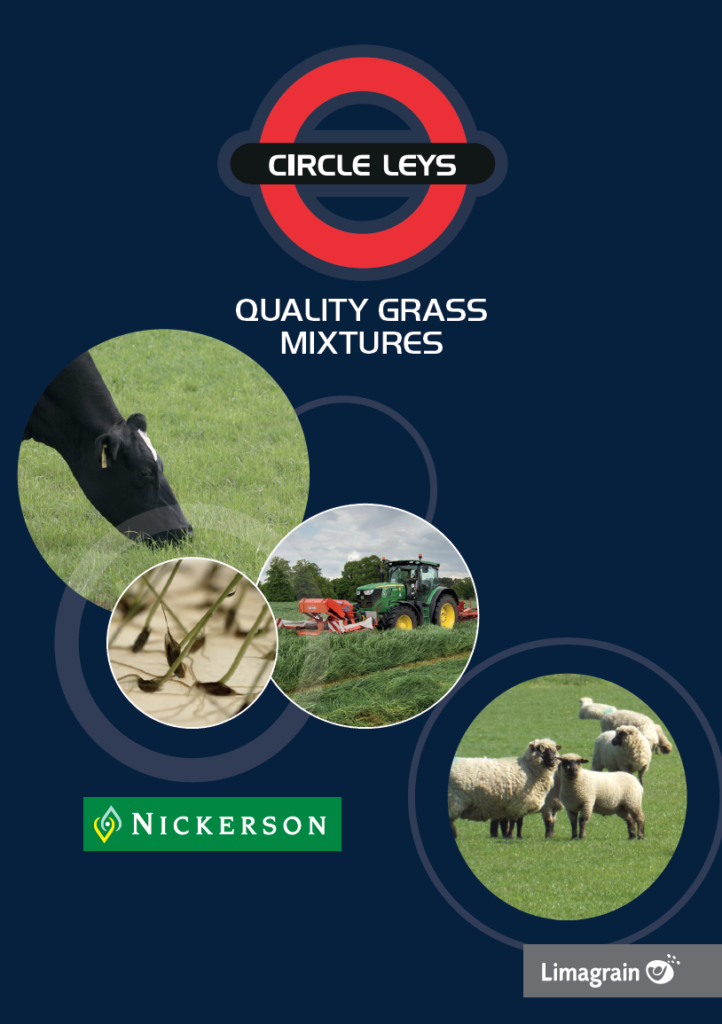
Circle Leys Brochure

To view the Circle Leys range, click here

Or contact your local Seed Specialist.
Forages to use with grass

While grass leys provide the backbone of all ruminant diets there are a plethora of other forages.

All these forages maximise their potential when matched with a quality Nickerson Circle Ley.

Maize
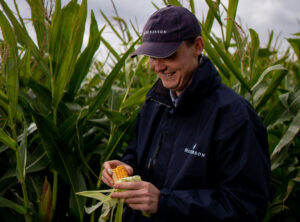
Fraser-House-in-maize-cropLG maize is a perfect complement to all Circle Leys, with excellent agronomic and feeding characteristics.

Fodder beet

LG fodder beet provides an excellent energy source combined with superb dietary fibre.

Lucerne

Lucerne offers a superb forage with the most rumen friendly protein source

Cereals

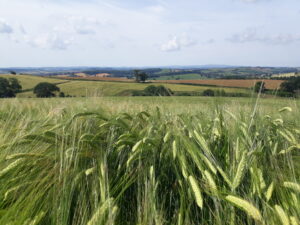
LG cereals offer many opportunities as a complementary feed in terms of wholecrop and grain using numerous different methods
More Information
Contact your local Seed Specialist.
What are GPA and SFC?

To improve establishment, most Circle Leys are treated with a GPA and Seed Film Coating as standard.

Growth Promoting Agent

GPA (Growth Promoting Agent) is a researched blend of nutrients essential for plant growth. These stimulate seedling germination, particularly under stress conditions and also encourage larger root systems, enabling the plants to absorb soil nutrients more efficiently.

Seed Film Coating

Seed Film Coating is a technique that forms a polymer film around the seed in which a range of conventional and innovative seed treatments can be carried. Seed Film Coating offers a number of major benefits to the seed and its application.

• Accurate application of GPA seed treatment
• Increased efficacy of the GPA
• Less dust in the seed
• Improved establishment

More Information

To learn more about Circle Leys, download the Brochure here.

Circle Leys Brochure

To view the Circle Leys range, click here

Or contact your local Seed Specialist.
What sets Nickerson seed quality apart?

The UK’s finest range of grass mixtures

Mixture trialling

Nickerson believe in the importance of mixture trialling. Recommended Lists from DARD, NIAB and SAC are used as a starting point, but these take little account of how individual varieties perform when grown together in a farmer’s grass ley. This is where Nickerson research begins. Circle-Leys-Trial-Site
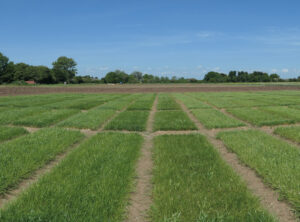
Mixture trialling is the key to ensuring that only the very best grass mixtures find their way onto your farm.

Highest seed standards possible

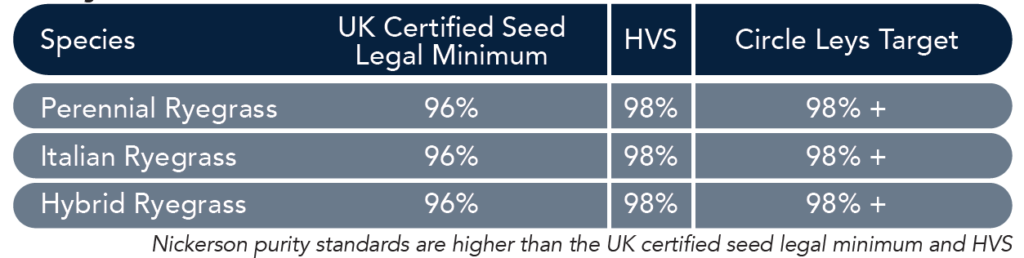
Good establishment is essential to achieve full production potential. Poor establishment results in weed invasion, increased poaching and loss of yield. Seed of the highest quality is therefore critical to achieve good establishment.

Germination standards
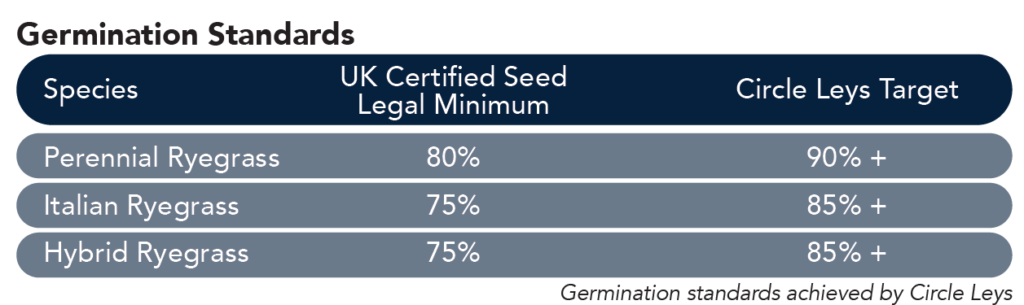
Nickerson Germination Standards

Purity standards

Purity Standards

More Information

To learn more about Circle Leys, download the Brochure here.

Circle Leys Brochure

To view the Circle Leys range, click here

Or contact your local Seed Specialist.
Why Circle Leys is trusted by generations; past, present and future

Over the last 70 years farming has evolved significantly.

However, during that time the one aspect that hasn’t changed is the need for high quality forage as grazed grass or conserved forage to feed ruminant animals.

Almost 70 years ago Fred Craven created a group of leys for Sir Joseph Nickerson designed with a specific purpose in mind. In the subsequent years we have added to this mixture range as farming has changed and we have adapted the mixtures accordingly.

Core benefits such as yield, disease resistance and other agronomic characteristics are vital to production and are attained through use of unique and varied varieties from a range of plant breeders worldwide.

Unashamedly we have remained totally faithful to the original thought process based around high quality forage. Dry Matter Intake and overall D-value/ME are the main drivers throughout the range, allowing the ruminant to maximise intake and therefore maintenance and production from forage.

More Information

To learn more about Circle Leys, download the Brochure here.

Circle Leys Brochure

To view the Circle Leys range, click here

Or contact your local Seed Specialist.