




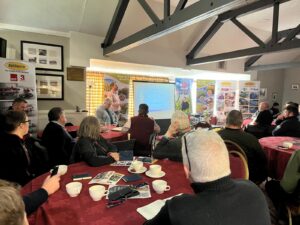
On 29th January, myself along with colleagues from the Northern Team, hosted an Alternative Forages Conference in and around Stocksfield and Ebchester, South Northumberland.
The event brought together industry experts, farmers, and stakeholders to discuss the benefits of home-grown forages in reducing costs, improving farm profitability, and minimising the environmental impact of livestock feeds, especially those that have been imported.
The day featured a number of insightful presentations from experts across the Industry:
- Lily Spencer Brown of Myton Foods emphasised the significance of home-grown forages for their operations, and the benefits they provide to producers. She also outlined Myton Foods’ producer schemes, specifically their beef production partnerships with multiple retailers, including Morrisons.
- Michael Carpenter, Technical Director of Kelvin Cave shared his extensive knowledge on conserving maize and grass silages. He also explored the inclusion of crimped and whole-cropped legumes in livestock diets and his involvement in the NCS research project, which investigates legumes as a source of home-grown protein.
- Tim Richmond, Maize Product Manager for LG Seeds highlighted the potential of Ultra Early maize varieties in the North, explaining how these varieties have revolutionized maize cultivation, by eliminating the need for plastic film.
- John Spence, Forage Crops Product Manager for LG Seeds outlined the importance of grass in the diet and the need to ensure that swards were regularly re-seeded to prevent a deterioration in both quality and yield.
Following the discussions, we then visited Broadoak Farm, where hosts Wayne and Geoff Bean demonstrated how they have successfully implemented the principles discussed during the conference.
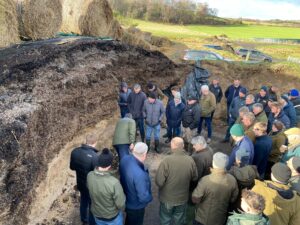
Myself and the Nickerson Northern team would like to thank all the guest speakers, and Geoff and Wayne Bean for their invaluable help with this event, and to Kelvin Cave Ltd for additional sponsorship.
We hope to see you at our next event!
More Information?
If you would like to know more about how these forages could help you on your farm please contact me on 07811 746804, david.watson@nickerson.co.uk
When asked what maize is grown for; livestock feed, AD or possibly even game cover would all be acceptable answers. A more unusual and downright creative use for this tall, dense and versatile crop that you probably haven’t considered is a maze.
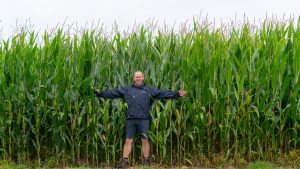
Jonathan Payne – Northern Sales Manager in a typically tall crop of LG31.207
This is what one of my customers has been growing his maize crop for, his maize maze is a very inventive diversification for the farm near Hornsea in East Yorkshire. The farm gates will be opened to the public for the month of October with other seasonally appropriate offerings such as pick your own pumpkins, strawberries and sunflowers. Jason Butler used Nickerson exclusive variety LG31.207 to establish his maize maze, the variety was chosen due to its high rating of 8 for standing and most importantly its notable height, both essential characteristics for a maze! The variety also has an FAO of 210, this later maturity was another key consideration when it came to variety choice. The maze doesn’t open until early October, so Jason was looking for something which would stay green throughout the time it is open to the public.
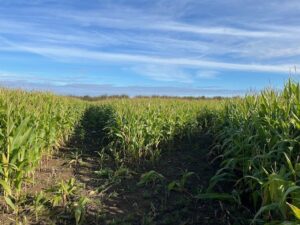
Establishing the maize maze near Hornsea
LG31.207 is a great variety for more traditional end uses as well. Opting for a later maturing variety suits farming systems on lighter soils which are supplying maize to an AD plant where quantity and staggered supply are required, LG31.207 fits this requirement nicely. With an early vigour score of 8.2, it emerges better and has the edge over other varieties of the same FAO group with lower early vigour scores.
Jason’s crop was drilled on 16th May, the crop has required very few inputs other than a pre-emergence herbicide – and it is looking great. The pathway for the maze was mapped early on so that it was easier to chop into, but also so that Jason doesn’t get lost in his own maze!
The maze opens 5th October so if you are in the area please call in to support what is an excellent diversification project and see how versatile our maize is.
A Word on Grass from Douglas BonnAs a new year starts thoughts of the coming season are not far away and the development of a grazing wedge or a good first cut of silage should be at the forefront of plans.
The key driver for all soil nutrition is pH and this ideally should be sitting around pH 6.5. Regular soil testing must be carried out to manage this factor. The type of fertiliser used makes a huge difference to the pH of the soil. The use of Calcium Nitrate (CAN) fertilizer has a lesser effect on pH with 1Kg reducing soil pH by 0.4 points where 1 Kg of Ammonium Nitrate and Urea will reduce it by 1.2 points.
A grass ley overwintering with too much growth can cause problems with disease and winter kill. Sheep winter grazing to reduce winter cover is a useful tool but if the goal is for an early grazing wedge or early first cut of silage sheep should be taken off the grass before the end of January.
Even with the best winter management there will always be an amount of winter kill to manage. In the resent years the introduction and development of the spring tine harrow has revolutionised the management of a grass ley. Running a grass harrow over a sward in early spring will remove any dead grass so creating space for new tillers it will also stimulate the first few centimetres of soil so absorbing atmospheric nitrogen.
The grass plant will “wake up” before visible signs show above ground. Over winter a grass plant loses much of its root mass, and this is the first part of the plant to grow as it comes out winter. The first 40 days of this process is key to provide the plant with the infrastructure to give the plant the nutrition it requires for the season .
I’ve made some assumptions when looking at the nutritional requirement for first cut silage or the development of a grazing wedge. I have assumed that the pH is 6.5, the soil indices are +2 and the expected yield of first cut silage is 25 tonnes per hectare @ 30% dry matter. The plant will therefore require 120Kg nitrogen (if soil pH is less than 6.5 and calcium content is less than 2,000mg/L CAN should be considered as the source of nitrogen), 40Kg of phosphate as P2O5, 80Kg potassium as K2O and 30Kg of sulphur as SO3.

Grass Ley January

Grass Ley March